


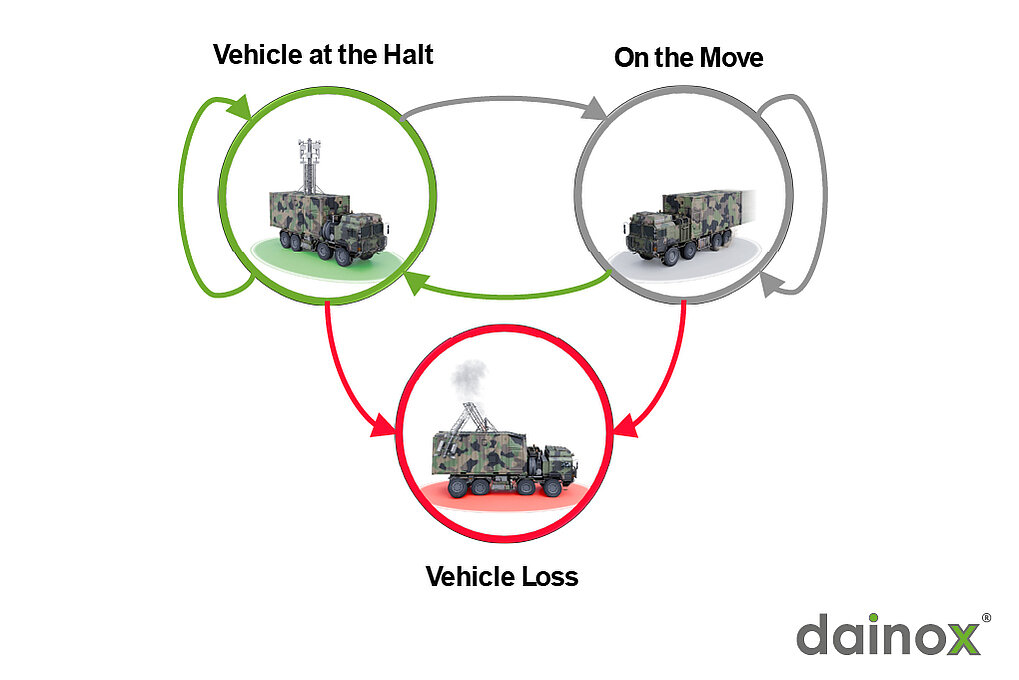
When the dainox SDMN® Approach 1.0 was first formally conceived and registered in the spring of 2019, the entire concept of “software-defined networking solutions” for military applications was, at the very least, unconventional and quite challenging. In line with this approach, the AutOr® product family continues to be purposefully expanded and applied for various FMN-compliant network solutions from dainox.
Due to qualitative and quantitative changes in the requirements for network capabilities in the operations “of tomorrow,” the existing solutions “of yesterday” will be deemed insufficient or not future-proof. It was therefore high time to analyze and evaluate these requirements in order to proactively adapt and expand the dainox SDMN® approach.
This publication marks the conclusion of a several-month-long in-depth evaluation of the specific requirements for VANETs in the context of LBO (Land-Based Operations) as part of SDMN® 1.5 The following short video illustrates—anonymously and from a “bird’s-eye view”—the future challenges in the field of IP networking:
These VANETs must necessarily possess a set (combination) of new technical features that, taken together, were not previously guaranteed and are still not guaranteed today: Air-Gapped | Self-Sufficient | On-Prem | Resilience | Highly dynamic and heterogeneous LOS/BLOS infrastructure | Node mobility | Zero-touch administration | “Exchange instead of troubleshooting.”
The central and essential principles of SDMN® 1.5 lie in the goal of cognitive routing, which aims to extend—or even partially replace—the classic static heuristics of conventional PBR with dynamic intelligence (SLM/SSM). From now on, the optimal routing decision is based on telemetry and context in near real time.
- SDMN® - Software Defined Mission Network
- AutOr® - Automation & Orchestration
- VANET - Vehicular Ad-hoc Networks